100 Years of Legacy
German by DNA
▾
1.5 MeV × 2 (60 mA × 2) Hybrid Crossfire Electron Processing System accelerators at our Pune plant cross-link cable insulation using electricity alone, giving cables that hold up to heat, oil and wear.

Disclaimer: Illustration of the e-beam facility; not to scale.
E-beam cables are made using electron beam processing. A focused beam of electrons irradiates the polymer in the cable's insulation and sheath and cross-links it, which strengthens its mechanical and thermal properties well beyond those of a conventional cable.
Our e-beam facility at the Pune plant in Maharashtra runs two electron beam accelerators and processes wire from 0.5 sq mm to 300 sq mm (1.5 mm to 3.5 mm diameter). We use it to produce specialised cables for industries where heat, chemicals and mechanical stress are part of daily operation.
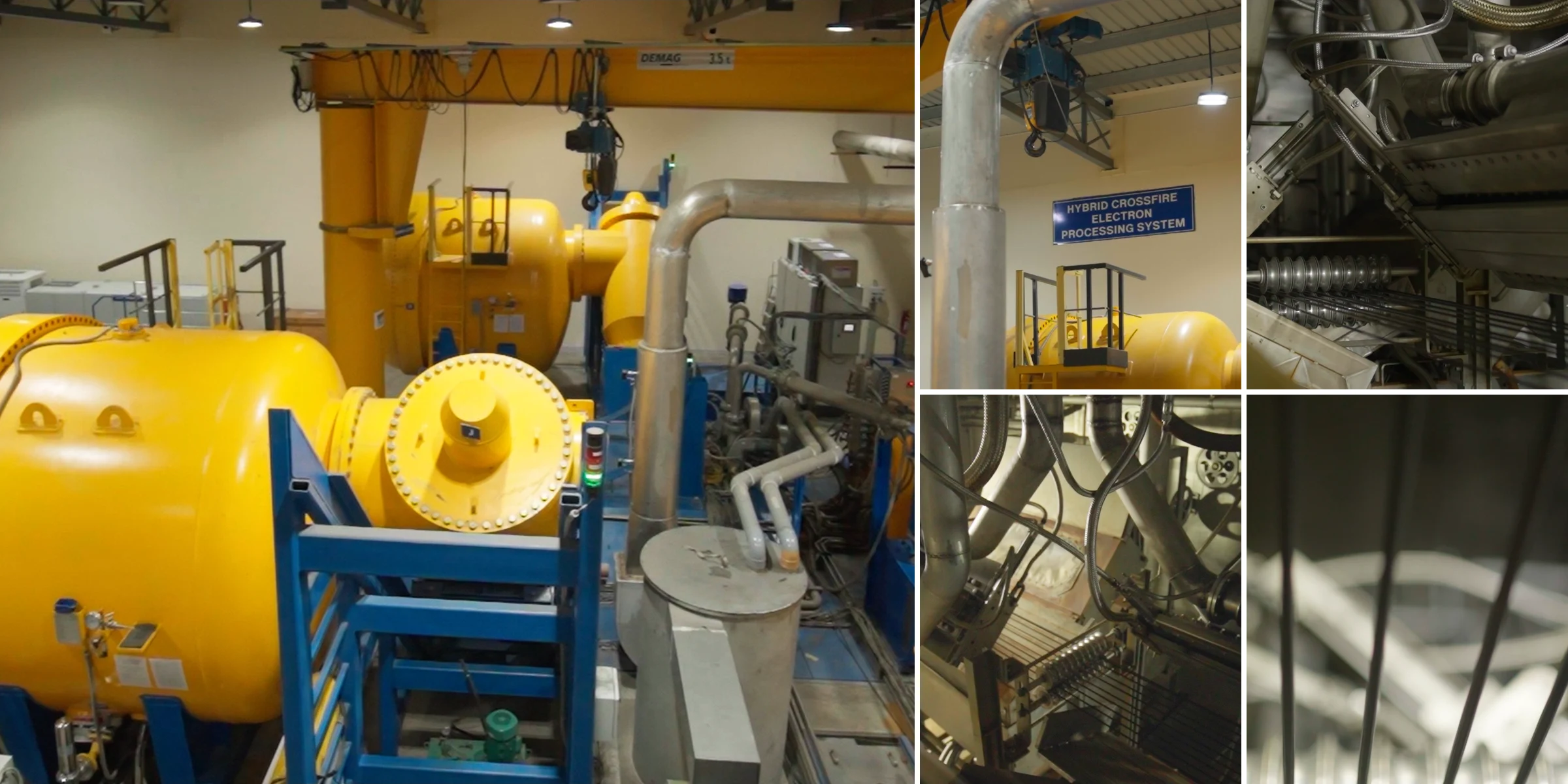
Insulation starts as long polymer chains that can slide past each other when they get hot. The electron beam joins neighbouring chains into a connected network, and that network is where the gains in heat resistance, strength and chemical resistance come from.
Our line runs on the linear accelerator principle. Electrons are accelerated, spread into a curtain and passed through the product, all in a single controlled step.
Insulation or sheath compound is extruded onto the conductor and wound, ready for treatment.
Electrons travel through a vacuum tube inside the Dynamitron® accelerator, reaching about 99.6% of the speed of light.
The beam is fanned out into an even curtain of accelerated electrons across the product path.
Wire runs through the curtain inside the shielded vault, where neighbouring polymer chains bond into a network.
Every batch is tested against its specification and documented for full traceability.
The beam runs on electricity, with no radioactive source and no chemical additives. That keeps process control reproducible, so quality stays consistent from one production batch to the next.
Cross-linking holds the polymer chains together, so the material keeps its shape where standard PE collapses.


Collapses and loses its round cross-section.


Holds its shape and stays serviceable.
Every electron beam cross-linked cable we produce is tested against this framework before it leaves the plant.
| Wire Size Range | 0.5 sq mm to 300 sq mm (1.5 mm to 3.5 mm diameter) |
| Tensile Strength | 15 to 30% improvement through cross-linking |
| Elongation | Enhanced elongation properties for flexible applications |
| Creep Resistance | Improved, for long-term reliability |
| Operating Temperature | −50 °C to +130 °C (varies by application) |
| Thermal Stability | Superior to non-cross-linked cables |
| At Extreme Temperatures | Electrical and mechanical properties maintained |
| Oils, Solvents & Chemicals | Excellent resistance to exposure |
| UV & Ozone | Resistant, for outdoor applications |
| Moisture & Humidity | Resistant, for sealed environments |
| Compliance | RoHS and REACH compliant manufacturing |
| Conductivity | Optimised for reduced signal loss |
| Insulation | Improved insulation properties through cross-linking |
| Electrical Stability | Enhanced across temperature ranges |
| Voltage & Frequency | Customisable to your requirements |
| Batch Testing | Rigorous testing of every e-beam cable batch |
| Manufacturing Process | ISO certified, AERB approval |
| Verification | Third-party verification of cable specifications |
| Traceability | Documentation for every specification parameter, maintained in SAP |
Electron beam cables serve industries where a cable failure is costly and the environment is hard on materials.
Rail, automotive and aviation cabling that holds up to vibration, mechanical stress and temperature swings.
TransportationBuilt for years of outdoor service on solar arrays and wind turbines, through UV, heat and weather.
Solar & WindpowerCables for extreme-condition and mission-critical use, where strength and heat resistance are specified.
DefenceCustom constructions for equipment makers, engineered for performance and long service life.
OEM / Custom solutionsWhy electron beam cross-linked cables are the preferred choice in critical applications.
Common questions from engineers and buyers about electron beam cross-linked cables.